Researchers expect a few gnarled limbs in their family tree. The records reveal the misdeeds of grand larcenists, snake oil salesmen, hustlers and, sometimes, murderers.
This case came to be known as “The Connor’s Creek Tragedy.” Elisabeth Hanly Lynch was murdered by her brother. In more than a dozen newspaper stories research found about this 4 January 1866 killing, Elisabeth’s given name received just one mention: in its diminutive form “Betsey” from the mouth of her killer in his testimony to the court. This narrative serves as a small gesture toward reclaiming her identity.
More than ‘Mrs. Wm. Lynch’
Elisabeth Hanly was born about 1827 in Ireland.1 During the trial, which started in May 1866, her husband William Lynch testified that they had married 14 years previously.2 That suggested they married around 1852, not long before son James was born 23 December 1854.3 William’s testimony, as reported in The Detroit Free Press, implied he and Elisabeth immigrated to the United States together but did not say when.
About four years after James’ birth, the family began to grow again. Daughter Elizabeth was born about 1858, followed by William Jr. around April 1860.4 The family of five was enumerated on the U.S. census 23 June 1860 in Grosse Pointe Township, Wayne, Michigan5:

- William Lynch, 30, born in Ireland, a farmer who did not own his land
- Presumed wife Elisabeth, 33, born in Ireland
- Presumed son James, 7, born in Michigan
- Presumed daughter Elizabeth, 2, born in Michigan
- Presumed son William, 2/12, born in Michigan
As discussed in the “Pinning Your Ancestors to a Map” post, the area of Grosse Pointe Township they lived in was known as Connor’s Creek.
Catherine and John were born 28 October 1862 and about 1863, respectively, suggesting they could have been twins.6 By 1866, when Elisabeth was murdered, she was mother to five: three boys and two girls, all under 13.
Genealogy Research Reveals a Murder
Research had long tried to resolve an identity issue regarding the wife of William Lynch. In the 1860 census, he was with wife Elisabeth, and in 1870, he was with wife Margaret.7 Both were noted as born in Ireland, and roughly around 1830 or so. Was this one woman, perhaps giving a middle name in one instance? Or was it different women?
A search for William Lynch in deed records found a purchase-money mortgage from 1863 between a William Lynch and a Daniel Corby.8 The deed mentioned no wife, Elisabeth or otherwise, but would not necessarily have done so. This William Lynch bought real property in Erin Township, Macomb, Michigan, and seller-financed it in a deal with Mr. Corby.
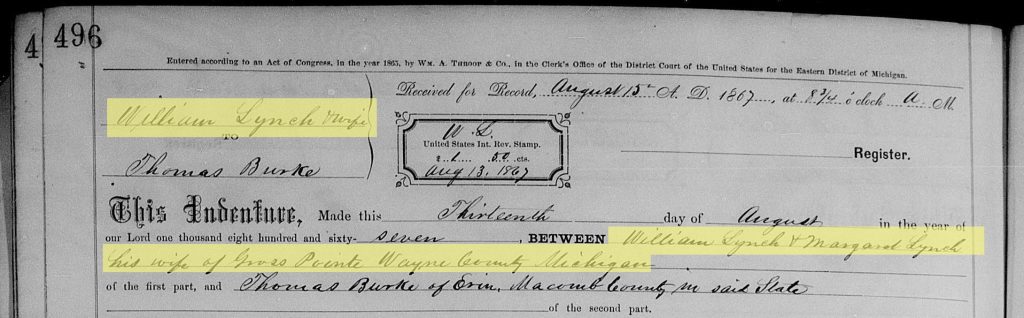
Evidence to support the two-wives theory came from a record of the sale of that property.9 When William sold it on 15 August 1867, the deed transfer read: “William Lynch + Margaret Lynch his wife of Grosse Pointe Wayne County Michigan.” Seeing the name “Margaret” connected to William in an original document several years before 1870 offered compelling evidence. Paired with the 1860 census, a more detailed theory emerged:
William had two wives: Elisabeth and then Margaret. Elisabeth died or deserted William between the summer of 1860 (the census) and August 1867 (the deed transfer). William and Margaret married by 15 August 1867, the date that deed was executed.
With the timeframe narrowed, research consulted FamilySearch’s full-text search and found an excerpt from a digitized book transcribing “vital records from the Detroit Free Press”10:
“LYNCH, ___ (Mrs.), w. of William Lynch) was murdered by her brother John Cooper alias John Hanley in Grosse Pointe Jan. 4th. (cf. F. P. issue May 4).”
Was this the untimely fate of William’s first wife?
The Crime of the Decade
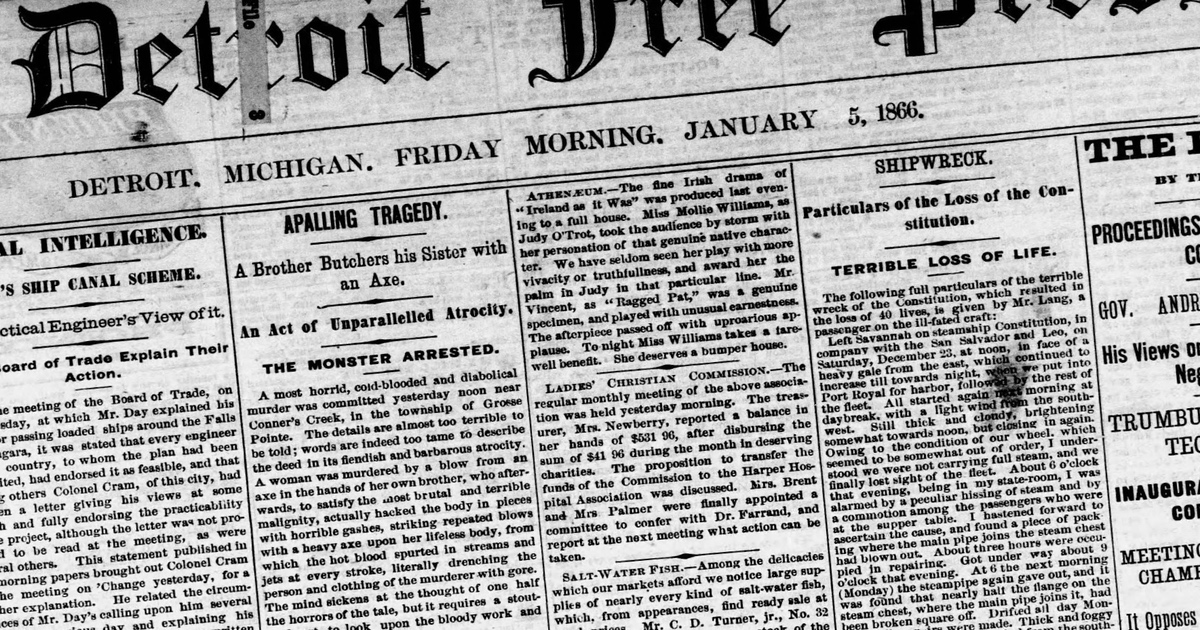
A derivative source, that digitized book, pointed to an authored source, the newspaper. Research turned to Newspapers.com, which had The Detroit Free Press issues for the 1860s. The digitized book offered several dates, starting with 5 January 1866. The headline about the murder ran at the top of that day’s front page11:
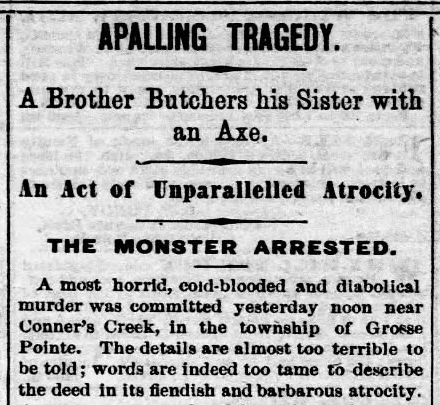
The story described the murder, which happened around noon the previous day, 4 January 1866. The detail was graphic, even as the vaguest outlines of the story would shock on their own. Husband William was working at the time and away. James was at school nearby. The axe attack erupted from a minor argument. Four children were home at the time: daughter Elisabeth, about 8; son William Jr., about 5; and Catherine and John, both about 3.
William Jr. ran to get James, but it was too late. James, William Jr. and a handful of neighbors alerted by the boys confronted the suspect at the door of the home. He tossed out his weapon and surrendered. William Sr. came home shortly after.
The news story stated the suspect was brought before Justice Daniel Corby, who ordered him jailed. Corby, having had a land contract with William since 1863, would have had some familiarity with the family.12
A Tense Arraignment for the Suspect
Betsey’s brother was arraigned a few days later, 8 January 1866.13 Crowds gathered and followed as “a strong posse of police” moved him from his holding cell to the courtroom. The newspaper described a tense scene.
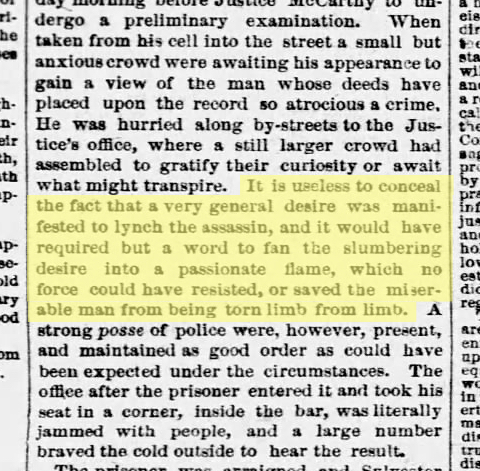
At the arraignment, defense counsel Sylvester Larned, Esq., who had volunteered his services, entered a plea of not guilty. Larned did not deny that Betsey’s brother had savagely killed her, but hoped “to clear him on the ground of insanity.”
After the hearing, men with the local justice’s office handcuffed the suspect and spirited him out the rear door of the court to dodge the angry crowds. He returned to jail to await the trial.
The Trial of Elisabeth ‘Betsey’ Lynch’s Murderer
The People vs. John Hanly, Alias John Cooper, was called to order 3 May 1866 in the Wayne County Circuit Court of Judge Benjamin F.W. Witherell.14 The Lynch family faced their brother-in-law and uncle in court. Neighbors, doctors, acquaintances and family all testified. Would justice be served in the murder Elisabeth Lynch?
This was the most intriguing part of the research from a genealogical perspective. Earlier research, written about here and here, fell short of a finding a record directly stating the link between James Lynch and potential parents William and Elisabeth Lynch. However, the 4 May 1866 edition of The Detroit Free Press featured a detailed account of the sworn testimony of family members, bringing it all together:
- William Lynch, Elisabeth’s husband, directly stated they had married 14 years earlier, and implied they immigrated together as a married couple. He also described their home in detail.
- Son James Lynch, “nearly 13 years of age,” mentioned siblings of the expected ages. He added: “I saw him [the suspect] last at Connor’s Creek the day my mother was killed.”
- And, in a sworn statement from William Lynch Jr., “a bright intelligent child, 6 years old, son of the murdered woman,” the boy directly mentioned two siblings by name: Jimmie (James Lynch) and Johnny (toddler John Lynch).
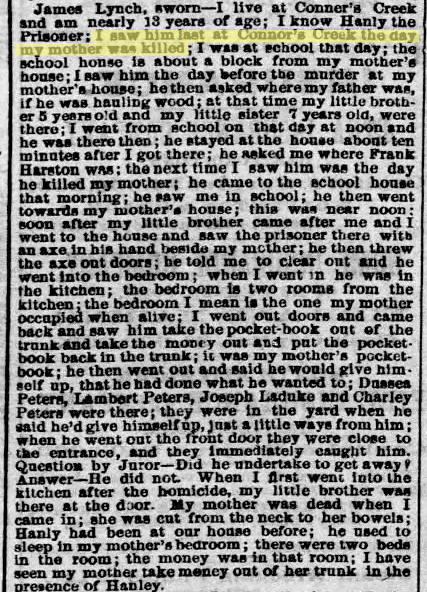
This testimony, as reported, directly supported proposed theories about the makeup of this family. Combined with evidence from property records, the testimony offered a bridge between the family’s makeup in 1860 and how it had changed by 1870.
William Lynch had married twice, the first time about 1852. His first wife, Elisabeth, mother of his five children, was murdered 4 January 1866 by her brother. By 15 August 1867, widower William married Margaret. Not long after, William and his family moved from Connor’s Creek, Wayne County, to a farm in Columbus Township, St. Clair County, where they were enumerated in 1870.
Knowing the weaknesses of newspapers as sources, research turned to the Archives of Michigan to attempt to find the original court files. Unfortunately, the files appeared to have not survived.15 The case should have appeared under the name of the defendant in the Wayne County Circuit Court case records (as The People vs. John Hanly, Alias John Cooper, or similar), but research found no matching names in the Index to the Criminal Calendar.
Coverage of this trial still added important evidence for the structure of this family. The reporter covering the trial wrote up the testimony almost as a stenographer would. It was clear from reading these stories that the reporter either attended the trial in person or had access to detailed transcripts. Without the original court case file, these newspaper accounts — despite being authored and secondary — still provided strong supporting evidence for all theorized relationships.
The Sentencing of Elisabeth ‘Betsey’ Lynch’s Murderer
The defense offered by Elisabeth’s brother when the trial opened bordered on bizarre. “The defense set up is that the man’s soul is not stained with the blood of a murderer,” the newspaper’s account read, “because that God had taken out from his being the living light of reason and substituted therefor the dark and murky cloud of insanity.” It continued: “… He has repeatedly spoken of himself as the illegitimate offspring of an Irish nobleman, and had been stolen by his murdered sister and reared in ignorance of his gentle parentage.”
Throughout the trial, he insisted his true surname was Cooper, and that Elisabeth had given him the name Hanly to hide his nobility.
Elisabeth’s brother, in addition to alleging she robbed him of a noble birthright, appeared to blame her for his failing marriage and a raft of other grievances. His insanity ploy failed. On 15 June 1866, Judge Witherell rejected a motion for a new trial and handed down a sentence of “imprisonment for life at hard labor.”16
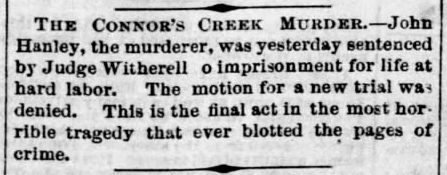
The Detroit Free Press item on the sentencing continued: “This is the final act in the most horrible tragedy that ever blotted the pages of crime.”
That ended the case of The Connor’s Creek Tragedy. This research added significant evidence for connections within this Lynch family in the transitional 1860-1870 years. It also showed a critical approach to “facts” from authored, secondary sources, and how to combine that information with other sources to answer questions of identity and provide vital context for understanding our ancestors.
Do you assistance with this type of deep research into your own family history? I can help. Tap or click the button below.
- United States (U.S.), 1860 Census, Wayne, Michigan, population schedule, Grosse Pointe Township, page 44 (penned), lines 9-13, dwelling 302, family 302, William Lynch household; imaged, “United States, Census, 1860,” FamilySearch (www.familysearch.org/ark:/61903/3:1:33S7-9BS4-DQH : accessed 15 May 2025) > Michigan > Wayne > Township of Grosse Pointe, image 44 of 53; citing National Archives and Records Administration. ↩︎
- “LOCAL INTELLIGENCE … THE CONNOR’S CREEK TRAGEDY … The Murderer’s Trial Commenced … Plea of Insanity Introduced,” news coverage of the trial of John Hanly “for the foul murder of his sister, Mrs. Wm. Lynch,” The [Detroit] Michigan Free Press, vol. XXIX, no. 284, 4 May 1866, p. 1, cols. 3-4; imaged, Newspapers.com (www.newspapers.com/image/1049353828 : accessed 1 July 2026), search “Hanly” and/or “Lynch” in 1866 in Detroit, Michigan. ↩︎
- Forest Lawn Cemetery (Saginaw, Saginaw County, Michigan), 3210 S. Washington Ave., Saginaw, MI 48601, James Lynch marker, section and plot unknown, coordinates 43.39331° N, 83.94947° W, personally read, 23 August 2024. Faint engraving: JAMES LYNCH, born Dec. 23, 1854, died Feb. 6, 1893, LYNCH, Erected by Sister. ↩︎
- United States (U.S.), 1860 Census, Wayne, Michigan, population schedule, Grosse Pointe Township, page 44 (penned), lines 9-13, dwelling 302, family 302, William Lynch household. ↩︎
- Ibid. ↩︎
- For Catherine: Michigan Department of State-Division of Vital Statistics, Certificate of Death, State File no. 655, Registered no. 240 (1916), Port Huron, Sanilace County, Katherine Mackley, 10 August 1916; imaged, “Death Certificates, 1897-1952,” Michiganology (www.michiganology.org : accessed 4 July 2026), search “Mackley” in Port Huron in 1916. For John: United States (U.S.), 1870 Census, St. Clair, Michigan, population schedule, Columbus Township, page 30 (penned), lines 4-14, dwelling 213, family 225, William Lynch household; imaged, “United States, 1870, Census,” FamilySearch (www.familysearch.org/ark:/61903/3:1:S3HT-D4PS-93Q : accessed 15 May 2025) > Michigan > St. Clair > Columbus, image 30 of 33; citing National Archives and Records Administration. ↩︎
- For 1860: United States (U.S.), 1860 Census, Wayne, Michigan, population schedule, Grosse Pointe Township, page 44 (penned), lines 9-13, dwelling 302, family 302, William Lynch household. For 1870: United States (U.S.), 1870 Census, St. Clair, Michigan, population schedule, Columbus Township, page 30 (penned), lines 4-14, dwelling 213, family 225, William Lynch household. ↩︎
- Macomb County, Mortage Record, vol. 28, 1863-676, pp. 193-195, William Lynch to Daniel Corby, received and recorded 20 October 1863, mortgage of lots 14-17 of the subdivision of the west part of the northeast quarter of Section 17, T1N R13E (situated in the town of Erin, Macomb, Michigan); imaged, FamilySearch (www.familysearch.org/ark:/61903/3:1:3Q9M-CSRG-THWC-M : accessed 29 June 2026) > Film # 008310834, images 444-445 of 678; citing Macomb County Courthouse, Michigan. William Lynch executes a purchase-money mortgage 20 October 1863 in connection with the acquisition of property in Erin Township, Macomb, Michigan, with a release of the mortgage recorded 29 October 1867. Release was recorded over p. 194 of original mortgage in book. ↩︎
- Macomb County, Record of Deeds, vol. 51, 1866-67, p. 496, William Lynch and wife to Thomas Burke, received and recorded 15 August 1867, purchase of lots 14-17 of the subdivision of the west part of the northeast quarter of Section 17, T1N R13E (situated in the town of Erin, Macomb, Michigan); imaged, FamilySearch (www.familysearch.org/ark:/61903/3:1:3Q9M-CSLF-VT1H : accessed 29 June 2026) > Film # 008194956, image 585 of 662; citing Macomb County Courthouse, Michigan. ↩︎
- “Vital records from the Detroit Free Press 1831-1868,” vol. XV, 1866-1868, p. 76, “LYNCH, MRS. ____” entry; imaged, FamilySearch (www.familysearch.org/ark:/61903/3:1:3Q9M-CSV7-PS1D-H : accessed 19 June 2026) > Film no. 008115480, image 852 of 1,053. ↩︎
- “APPALLING TRAGEDY … A Brother Butchers His Sister with an Axe,” initial news coverage of the death of “Mrs. William Lynch” at the hands of brother “who calls himself John Hanly, but whose real name is John Cooper,” The [Detroit] Michigan Free Press, vol. XXIX, no. 182, 5 January 1866, p. 1, col. 4; imaged, Newspapers.com (www.newspapers.com/image/1048531672 : accessed 1 July 2026), search “Hanly” and/or “Lynch” in 1866 in Detroit, Michigan. ↩︎
- Macomb County, Mortage Record, vol. 28, 1863–676, pp. 193–195, William Lynch to Daniel Corby, received and recorded 20 October 1863, mortgage of lots 14–17 of the subdivision of the west part of the northeast quarter of Section 17, T1N R13E (situated in the town of Erin, Macomb, Michigan). ↩︎
- “LOCAL INTELLIGENCE … THE MURDERER COOPER. … His Arraignment—Exciting Scene at the Justice’s Office,” The [Detroit] Michigan Free Press, vol. XXIX, no. 185, 9 January 1866, p. 1, col. 2; imaged, Newspapers.com (www.newspapers.com/image/1048532752 : accessed 1 July 2026), search “Cooper” and “Lynch” in 1866 in Detroit, Michigan. ↩︎
- “LOCAL INTELLIGENCE … THE CONNOR’S CREEK TRAGEDY. … The Murderer’s Trial Commenced.,” The [Detroit] Michigan Free Press, vol. XXIX, no. 284, 4 May 1866, p. 1, col. 3; imaged, Newspapers.com (www.newspapers.com/image/1049353828 : accessed 1 July 2026), search “Hanly” and “Lynch” in 1866 in Detroit, Michigan. ↩︎
- Wayne County Circuit Court, Index to the Criminal Calendar B, alphabetical by defendant surname, nil search for Cooper or Hanly (and variations); Archives of Michigan, 702 W Kalamazoo St, Lansing, MI 48915, RG 85-34, vol. 81, sections for letters C and H, reviewed by genealogist Jeremy Verdusco, 16 July 2026. ↩︎
- “THE CONNOR’S CREEK MURDER.–John Hanley, the murderer, was yesterday sentenced by Judge Witherell to imprisonment for life at hard labor.,” The [Detroit] Michigan Free Press, vol. XXX, no. 127, 16 June 1866, p. 5, col. 4; imaged, Newspapers.com (www.newspapers.com/image/1049362094 : accessed 1 July 2026), search “Hanley” in June 1866 in Detroit, Michigan. ↩︎