Do you have ancestral lines that you know just must be true, even though you can’t prove them? This post, originally published in the summer 2026 issue of the Michigan Genealogical Council Quarterly, focuses on the same Lynch family I discussed in the Quarterly’s spring issue, but we go back a little further in time.
To set the scene for this family, William Lynch fought in WWI and died of consumption in a Washington, D.C., hospital in the 1920s. His parents were James Lynch and Jane Freeman, at Carrollton, Saginaw County, by about 1880. I believe James’ father was also named William, and I’ve tried to prove that link for years.
I think I even know which William Lynch is James’ father. He was enumerated in the 1870 census at Columbus Township, St. Clair, Michigan. Jane’s obituary said she and James married in Memphis, Michigan, which just happened to be the town nearest to that 1870 farm. But, while I think the James enumerated in 1870 at Columbus Township is the same person Jane married, I’m not 100% sure. James Lynch and William Lynch are common names.
Being a genealogist, though, I couldn’t resist researching this earlier William Lynch, just in case.
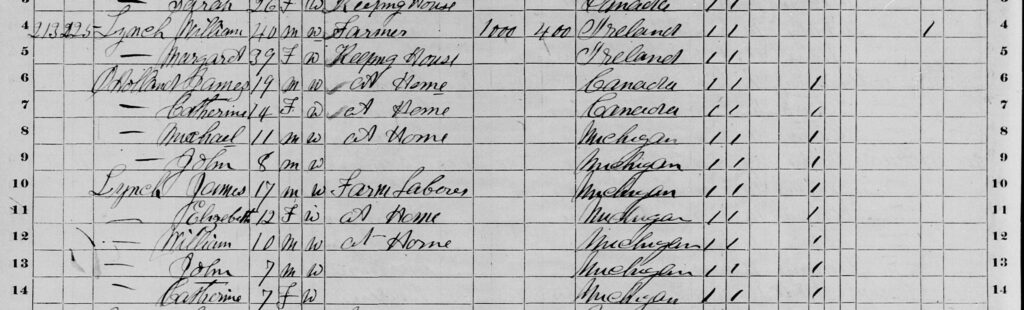
In 1870, this William, 40, was married to a Margaret Lynch, 39, both born in Ireland. For this article, we’ll skip the other children and household members, and focus on James, who is 17 here and born in Michigan, and presumed father William. Online trees had placed this William in Grosse Pointe Township, Michigan, but of course I had to find out myself.
The 1860 enumeration in Grosse Pointe Township (not pictured here) had many parallels. The children expected to be 10 years younger were present, including a James, who was 7. Here though, the William Lynch, 30, born in Ireland, appeared with presumed wife Elisabeth, 33, born in Ireland. Importantly, he was a farmer who did not own his land. Was he the same William who also appeared in Columbus Township in 1870?
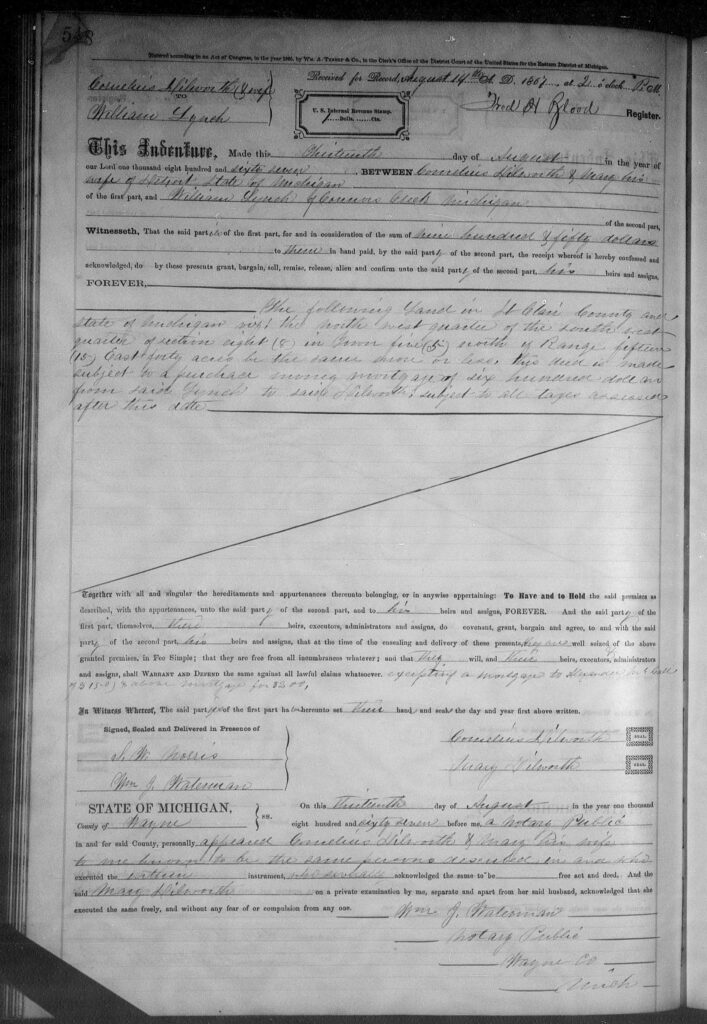
I dug into St. Clair County deeds to confirm the connection. Sure enough, I found a “William Lynch of Connors Creek Michigan” buying 40 acres in Columbus Township in the summer of 1867. The seller was named Cornelius Dilworth. The document did not mention a wife — Elisabeth, Margaret or otherwise. A quick search for “Connors Creek” revealed that it was a name once used for a northwestern area of the Grosse Pointes. We seemed to have a match, despite the change in wives from 1860 to 1870.
I wanted to confirm further, and I like to place people on a map if I can. Recall that William did not own the land he worked in 1860. Knowing that, I looked down that census sheet and found the next major landowner, a fellow named Eustachius Tremblay, who appeared to have $4,000 in real estate. The next step was finding a contemporary map.
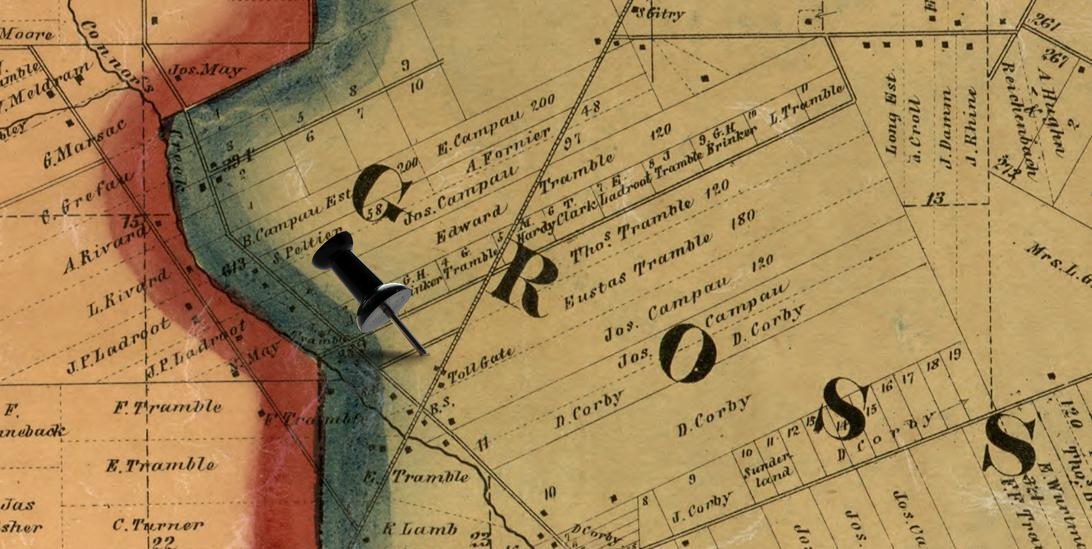
For the map, I got lucky. The Library of Congress had a map of this area for this exact year, 1860. Sure enough, right by the R in Grosse Pointe sat the farm of Eustas Tramble. I think it was probably a safe bet that the names “Eustas Tramble” and “Eustachius Tremblay” were phonetic variants of the same thing.
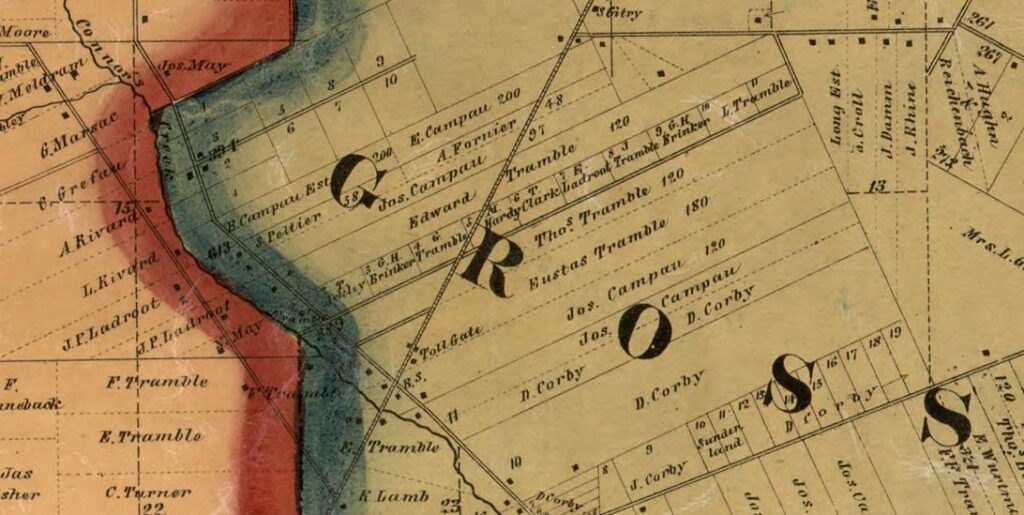
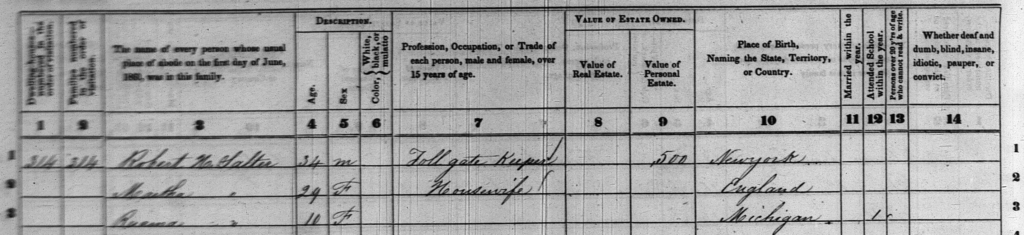
Keen eyes will see on the map that “E. Tremble” owned several parcels, so William could have lived really anywhere in this area, but we know we’re in the vicinity of where he farmed in 1860. And, to really put a proper punctuation mark at the end, if you page two sheets forward in that 1860 census, you find a man named Robert McSalter. He’s enumerated as a “toll gate keeper.” Drawn on that 1860 map, near the modern-day intersection of Gratiot and Conner, you can see the words “Toll Gate” (see the pin in the image leading this post).
With all these tidbits, we can draw a sketch of this period in William’s life. He and first wife Elisabeth were in the States in Grosse Pointe Township, or Connor’s Creek, by sometime in the early 1850s, likely fleeing the Potato Famine. They had several children, the first a boy named James, starting around 1852 in Michigan. At some point before about 1867, Elisabeth appeared to have died. William later bought land in Columbus Township, then remarried, this time to a woman named Margaret. He and second wife Margaret were enumerated in 1870 in Columbus Township. The man I strongly suspect to be my third great-grandfather, James Lynch, appeared on both census documents — I just can’t definitely say it’s him.
I believe my James married Jane Freeman in nearby Memphis in 1878, the year before their first child was born — my great-great-grandmother Blanche — in 1879. (Jane’s obit said in the marriage occurred Memphis in 1887, but — because of Blanche’s birth year — I suspect the numbers got transposed in the newspaper.) It all fits. But, as with any research, just because an explanation fits, that doesn’t mean it isn’t the only explanation that fits. The James Lynch in Columbus Township in 1870 could have beat the same wagon paths as another James Lynch with a different father I haven’t yet found. I honestly don’t know.
One day, however, when I can prove the connection between James and William, I’ll already have a solid base of research into the man I suspect is my fourth great-grandfather.
Need help with this type of deep family history research? Click Book a Call for a free, 15-minute consultation.