Thousands of Americans with Canadian ancestry are currently exploring Canadian citizenship by descent. For many families — especially those with roots in Detroit and other areas across Michigan — the records needed to prove eligibility may exist on both sides of the border.
When birth records, marriage records, or direct evidence are missing or hard to find, genealogical research and indirect evidence can become critical to successfully proving Canadian descent. The first question from a potential client usually sounds something like, “What records do I need to prove Canadian citizenship by descent?” Experienced genealogists can help clients navigate that question.
The answer is usually easier — and tougher — than clients expect.
Proving Citizenship by Descent: The Good and Bad News
First, the good news: “Proving” citizenship by descent — whether for Canada or another country that allows it — often involves fewer documents than people might think. That may sound counter-intuitive. More evidence is good, right? Not necessarily. We want to keep it simple. In the case of Canada, remember that the folks at Immigration, Refugees and Citizenship Canada (IRCC) reviewing applications are reviewing thousands of applications. We should help them out by getting right to the point.
Second, the less-good news: “Proving” citizenship by descent — whether for Canada or another country that allows it — often involves higher-quality documents than people might think. What do I mean by higher quality? As much as possible, proofs for citizenship for Canada or another country need to be made with “primary” information sourced from original documents. If an original source is still available, applicants often need to get a copy of that source from the issuing authority. If an original document no longer exists, applicants will need to describe their unsuccessful efforts to find that document.
When you think about the quality of the documents you base your proof on, think in “eye-witness” terms. You want documents completed by participants in an event, preferably when the event happened. Birth, marriage and death certificates can all involve “eye-witness” level information about the event in question. A newspaper obituary or indexed record found on Ancestry.com does not.
Using Indirect Evidence to Prove Canadian Citizenship by Descent
Proving a link between generations might sometimes require indirect evidence. For example, if you’re having trouble connecting your zero generation to your first generation. (The “zero” generation is the generation that crossed the border, sometimes called Gen Zero.) You may have found a ton of records, but none of them directly state the relationship.
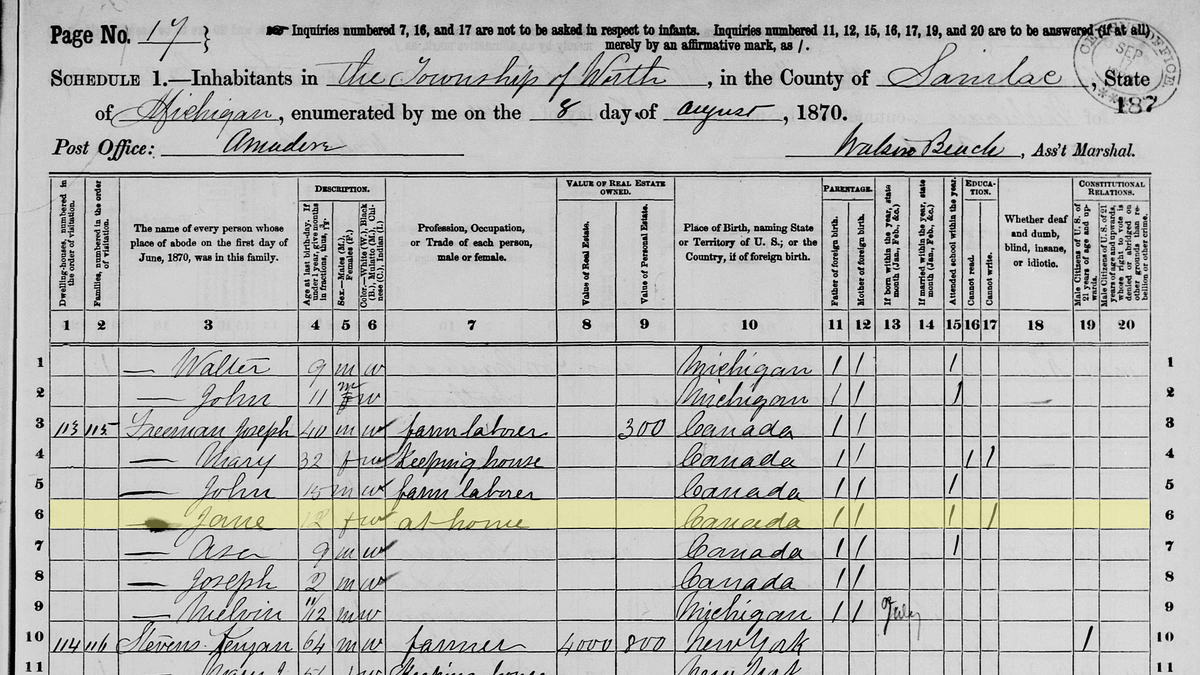
In my own family, the death certificate for my Canada-born third great-grandmother Jane names her parents as “John Freeman” and “Rose Chilton.” That directly answers the question of who her parents were. However, her parents in every other source I’ve found were listed as “Joseph Freeman” and “Mary Chilton.” A case like this would require other documents to establish that John and Rose and Joseph and Mary were, in fact, the same couple.
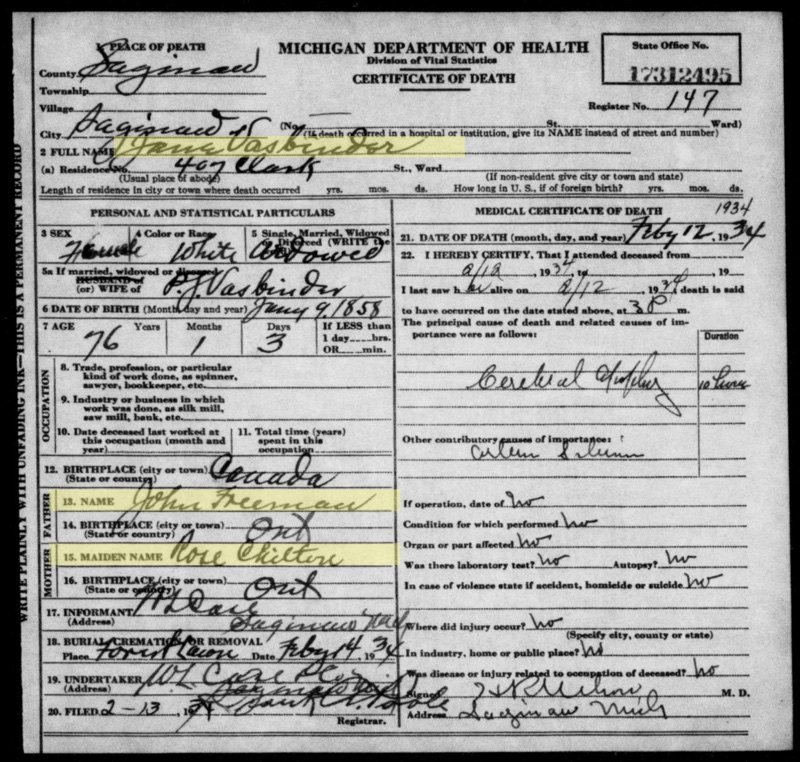
Jane’s death certificate is what I would normally consider a “high-quality” source, but the discrepancy forces me to downgrade the evidence it provides. I could, however, use Jane’s death certificate as part of an indirect proof that points to the same conclusion. Those other documents might include census, marriage, probate or other records that show Jane with parents named Joseph and Mary.
Building a Strong Proof Package for Canadian Citizenship by Descent
Applicants sometimes (mistakenly) think they can just print out documents from Ancestry.com and mail them in. That can result in a very long detour on the way to approval by the IRCC or another government citizenship body.
It seemed for a few months early in 2026 that just about anything might be accepted as proof for Canadian citizenship by descent. The IRCC, however, clarified their rules in late spring 2026. They want to see “official documents issued by the original authority.”
That speaks to the “high-quality” aspect discussed earlier. Applicants need original records where possible and, where not possible, a paper trail of efforts to show why those records are unavailable. For example, proofs depending on a female ancestor will likely require a marriage record to document her surname change. If a woman’s marriage predates civil marriage records, applicants might include a written explainer on when civil marriage record-keeping started in that area. Even then, we’d still want to locate a religious marriage record to take the place of that missing civil record.
To sum things up, it’s best to take the quickest and easiest route: for the applicant, for any legal or genealogical helpers she has, and for the clerks reviewing the application. That means:
- Provide high-quality documents from the original issuing authorities directly linking each generation in the chain of descent, from Gen Zero to the applicant.
- If the direct line of descent includes a female ancestor, the application should include a marriage certificate or other record showing her name change.
- Where records directly stating any one of the links in the chain of descent are unavailable, the application should include documents from original authorities that, when combined, make a clear “indirect” argument for that link.
Help from a Genealogist with Citizenship by Descent
Genealogists can help in a variety of ways with research for citizenship by descent, from providing simple advice to locating records to putting together an entire proof document to accompany the application. The level of rigor required goes way beyond finding documents on Ancestry.com. It involves:
- Planning research to find the most effective path to success.
- Finding documents to support the proof. The hardest part of this process is figuring out who has the documents needed to prove the citizenship by descent, and how long they take to deliver certified copies.
- Correlating evidence for the proof, and looking for weak links in the evidence that might give a reviewer pause.
- Writing a solid, well-supported proof argument that builds on the evidence found within available sources to make the strongest case possible for your citizenship by descent.
Are you considering applying for Canadian citizenship by descent? Tap or click the Book a Call button for an initial consultation. As a member of the Association of Professional Genealogists and an at-large board member of the Michigan Genealogical Council, I have experience working with clients to locate hard-to-find documents in both the United States and Canada. Whether you just need a professional assist with those difficult-to-connect generations, or want a more in-depth research partner, I can help.